
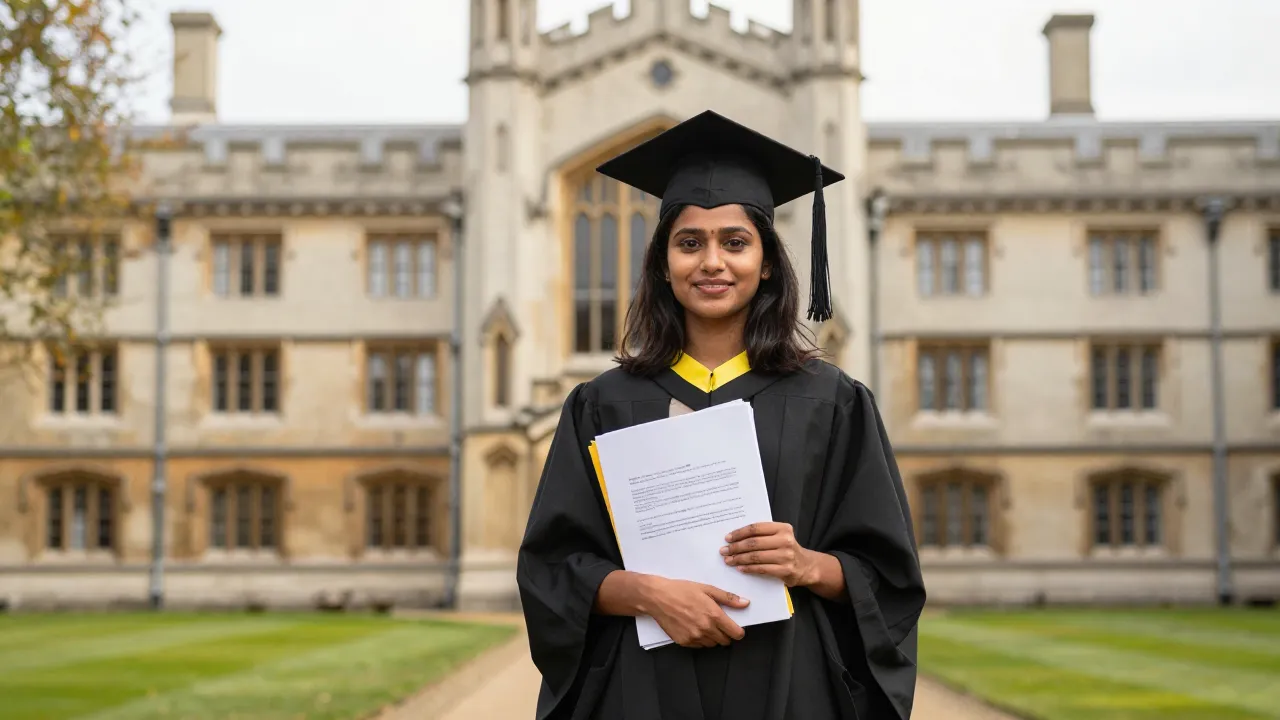
UK Scholarships for Indian Students in 2026: The Direct Answer
UK scholarships for Indian students in 2026 range from fully funded government awards like Chevening (worth up to £22,000+ in tuition alone, plus living costs and airfare) to partial university awards like GREAT Scholarships (£10,000 towards one year of tuition). The strongest routes for Indian applicants right now are Chevening, Commonwealth, the Felix Scholarship, GREAT Scholarships, Scotland’s Saltire Scholarship, and dozens of individual university merit awards — most open between August and March for a September intake. Deadlines are the single biggest reason strong applicants miss out, not the essays.
Every year we sit across the table from a student who scored well, wrote a decent Statement of Purpose, and still lost a scholarship they were genuinely competitive for — because they applied to the university two weeks after the scholarship’s internal cut-off, or because they didn’t realise a scholarship needed an unconditional offer letter before you could even submit. That’s the gap this guide is built to close.
If the cost of studying in the UK has already made you nervous, you’re not imagining it. We’ve broken down the real cost of studying in the UK for Indian students in 2026 elsewhere on this site, and the numbers are exactly why scholarships matter more this year than they did three years ago — tuition and maintenance funds have both climbed, and the visa financial requirement now sits at £1,529 a month in London.
Table of Contents
- Why UK Scholarships Matter More in 2026
- 9 UK Scholarships Worth Applying For
- Comparison Table: Amount, Deadline & Competitiveness
- Pros vs Cons: Government Scholarships vs University Scholarships
- Eligibility, Documents & Timeline Table
- 7 Mistakes That Cost Indian Students Real Scholarships
- Expert Tips From 15 Years of Counselling
- Real Student Success Stories
- FAQs
- Final Word
Why UK Scholarships Matter More for Indian Students in 2026
A one-year UK master’s now costs Indian families anywhere from ₹18 lakh to ₹45 lakh once tuition, London or non-London living costs, and visa maintenance funds are added up. That’s not a typo — it’s roughly what a flat in a tier-2 Indian city costs, spent on twelve months abroad.
Scholarships change that equation directly. A Chevening or Commonwealth award doesn’t just cover fees — it wipes out the maintenance-fund headache too, because the CAS (Confirmation of Acceptance for Studies) can show the scholarship as your source of funds instead of a bank statement your parents had to freeze for 28 days.
The three groups of Indian students who benefit most:
- Students with strong academics (65%+) but limited family savings for a full self-funded master’s
- Working professionals with 2+ years of experience aiming for Chevening or a Commonwealth-eligible course
- Undergraduate applicants targeting university-specific merit scholarships that don’t require work experience
9 UK Scholarships Worth Applying For in 2026
1. Chevening Scholarship — Fully Funded, Government-Run
The Chevening Scholarship is the UK government’s flagship award and the one most Indian students have heard of. Applications for the 2026-27 cycle opened on 4 August 2026 and close on 6 October 2026 — a two-month window that catches out more applicants than the essay questions do.
It covers full tuition (MBA tuition is capped separately, often around £22,000), a monthly living stipend, a return economy flight, and visa costs, for a one-year taught master’s. You need at least two years of work experience (2,800 hours) after your undergraduate degree, and you must apply to three different eligible UK master’s courses, securing an unconditional offer from at least one before the deadline. There’s no getting around the work-experience clock — if you graduated last month, this cycle isn’t yours yet.
2. Commonwealth Scholarship — Fully Funded, Development-Focused
Run by the Commonwealth Scholarship Commission, this covers full tuition, a monthly stipend (£1,452 outside London, £1,781 in London), and return airfare for a one-year taught master’s. The catch most guides skip: your chosen course has to map to one of the CSC’s six development themes, and MBA programmes generally aren’t funded. A 60% undergraduate average is the working benchmark, though a lower second class can still qualify alongside a relevant postgraduate qualification.
3. GREAT Scholarships — Partially Funded, University-Delivered
The GREAT Scholarships, jointly run by the British Council and the UK government’s GREAT Britain Campaign, offer a minimum £10,000 towards one year of postgraduate tuition. For 2026-27 there are 12 awards across partner universities including Bristol, Surrey, Reading, Dundee, Queen’s University Belfast, and several arts-focused institutions. It’s not fully funded — you’ll still need to cover the balance and living costs — but £10,000 off a £20,000-£25,000 course is a meaningful dent, and the applicant pool is far smaller than Chevening’s.
4. Felix Scholarship — Fully Funded, Need-Based, India-Specific
One of the few UK scholarships built specifically for Indian nationals. The Felix Scholarship, administered through SOAS with awards also available at Oxford and Reading, covers full tuition, living costs, and a return flight for a full-time master’s or PhD. It’s explicitly need-based — you have to demonstrate genuine financial need, not just academic merit — and requires at least a first-class bachelor’s degree from an Indian university (a strong master’s can offset a second-class bachelor’s in exceptional cases). The 2026 deadline was 2 March; expect the 2027 window to open around December-January.
5. Scotland’s Saltire Scholarship
Worth around £8,000 towards a one-year postgraduate master’s at any Scottish university, focused on STEM, healthcare, and creative industries. Scotland’s living costs run noticeably lower than London’s, so this stacks well for students prioritising affordability over the London brand-name effect.
6-9. University-Specific Merit & Country Scholarships
Nearly every major UK university runs its own India-specific award — usually £2,000 to £10,000 off tuition, automatically considered when you apply, or requiring a short separate form. Examples worth checking directly on the university’s own funding page: the University of Birmingham’s Global Justice and India scholarships, Warwick’s Chancellor’s International Scholarship, Manchester’s India Excellence Scholarship, and Coventry’s international merit awards. These move faster than government scholarships and often have rolling deadlines tied to your offer date rather than a fixed calendar date — which is exactly why timing your application matters as much as your grades.
Comparison Table: UK Scholarships for Indian Students at a Glance
| Scholarship | Funding Type | Typical Amount | 2026-27 Deadline | Work Experience Needed |
|---|---|---|---|---|
| Chevening | Fully funded | Full tuition + stipend + flight | 6 Oct 2026 | Yes (2 years) |
| Commonwealth Scholarship | Fully funded | Full tuition + stipend + flight | Varies (Nov-Dec, check CSC) | Not always required |
| GREAT Scholarships | Partial | £10,000 towards tuition | Varies by university (Feb-May) | No |
| Felix Scholarship | Fully funded, need-based | Full tuition + living + flight | ~2 March 2027 | No |
| Saltire Scholarship | Partial | ~£8,000 | Varies (Feb-June) | No |
| University merit awards | Partial | £2,000-£10,000 | Rolling, tied to offer date | No |
Deadlines shift slightly year to year — always confirm the current cycle’s exact date on the scholarship’s official page before you plan around it.
Pros vs Cons: Government Scholarships vs University Scholarships
| Pros | Cons | |
|---|---|---|
| Government scholarships (Chevening, Commonwealth, Felix) | Fully funded, prestigious, strengthens future visa/job applications, no repayment | Extremely competitive, narrow eligibility windows, long application timelines (6-9 months) |
| University scholarships (GREAT, merit awards) | Faster decisions, higher acceptance odds, often auto-considered with your application | Rarely covers full cost, amount varies year to year, doesn’t reduce visa financial-requirement burden as much |
Eligibility, Documents & Application Timeline
| Stage | What You Need | When to Start |
|---|---|---|
| Academic eligibility | 60-70%+ undergraduate average (varies by scholarship); some need work experience | Ongoing — keep transcripts ready |
| English proficiency | IELTS (usually 6.5-7.0 overall) or equivalent; check if your university offers a waiver | 4-6 months before deadline |
| University offer | Most scholarships (Chevening, GREAT, merit awards) need an active or unconditional offer | Apply to universities 8-10 months before intake |
| Documents | SOP, 2-3 recommendation letters, transcripts, financial-need proof (for Felix/Commonwealth), CV | 3-4 months before deadline |
| Interview stage | Chevening and Felix both interview shortlisted candidates | Feb-May, after shortlisting |
| Visa & CAS | Scholarship confirmation letter used as financial evidence on your CAS | After scholarship award, before visa application |
If your scholarship application overlaps with visa planning, it’s worth reading through the common UK student visa rejection reasons early — a scholarship letter that doesn’t clearly state the funding amount and duration is one of the quieter causes of financial-requirement queries at the visa stage.
7 Mistakes That Cost Indian Students Real Scholarships
1. Applying to the university after the scholarship’s internal deadline. Most students track the scholarship deadline and forget that university admission has its own, earlier cut-off — and you often need an offer in hand before the scholarship portal will even let you submit.
2. Treating the SOP as one document for every scholarship. Chevening wants leadership and impact stories. Felix wants financial-need honesty. A recycled SOP reads generic to both panels.
3. Missing the “unconditional offer” requirement. A conditional offer (pending final-year marks) doesn’t count for several scholarships. If your final semester runs late, plan your application sequence around that.
4. Skipping smaller university awards to chase Chevening alone. Chevening accepts roughly 1-2% of applicants globally. A £5,000 university award you’re 70% likely to get is often the better bet financially than a 1% shot at full funding.
5. Not budgeting for the gap. Even “fully funded” scholarships sometimes cap flight costs or don’t cover dependents. Families who assume 100% coverage get blindsided by the real cost of studying in the UK anyway.
6. Weak or generic recommendation letters. A professor who barely knows you writing “an excellent student” carries less weight than a supervisor detailing one specific project you led.
7. Applying without a financial back-up plan. Scholarship panels take months to decide. Apply for your visa’s financial requirement in parallel — don’t wait on the scholarship outcome to start that clock.
Expert Tips From 15 Years of Counselling Students Into the UK
Start your scholarship shortlist the same week you shortlist universities, not after you’ve received an offer. The two processes run on overlapping but different clocks, and students who treat scholarships as an afterthought consistently miss the better-funded options.
Apply to at least one government scholarship (Chevening or Commonwealth) and two to three university-level awards in parallel. It’s not hedging — it’s how most successfully funded students actually get through, since the acceptance math on any single fully funded award is genuinely tough.
If your undergraduate percentage sits in the 55-65% range, don’t rule yourself out of Commonwealth or university merit awards — a strong postgraduate qualification or clear upward trend in your marks matters more to most panels than one weak semester.
And if English proficiency is a concern, check the university’s own IELTS waiver policy before booking a test — many UK universities waive it for students who’ve studied in English-medium institutions, and that saved fee can go straight into your visa maintenance fund.
Real Student Success Stories
The profiles below are composite, illustrative scenarios built from patterns we see repeatedly in counselling — not verified individual case studies.
Ananya, Pune — 68% in B.Com, aiming for a Master’s in Public Policy. Ananya assumed her non-STEM background ruled her out of most funded routes. She applied to a Commonwealth Scholarship (development-themed courses covers public policy) and two university merit awards as backup. She missed Commonwealth by a narrow margin but secured a £7,000 university award at a Russell Group university, cutting her family’s total cost by nearly a third.
Rohit, Ahmedabad — 3 years’ work experience in fintech, targeting an MBA. Rohit’s biggest mistake almost cost him Chevening entirely: he didn’t realise the three-course application rule meant he needed three separate unconditional offers, and he’d only applied to one university by August. A tight six-week sprint to get two more applications in got him the offers he needed before the 6 October window closed. He’s currently on a Chevening-funded MBA.
Meera, Bengaluru — first-class bachelor’s, family income under ₹6 lakh annually. Meera didn’t think she could afford a UK master’s at all until she learned about the Felix Scholarship’s need-based criteria. The application asked her to be direct about her financial situation rather than downplay it — a shift in approach that changed how she framed her entire SOP. She’s now in her second year of a fully funded programme.
Arjun, Delhi — 72% in Computer Science, no work experience. Arjun assumed scholarships required years of experience like Chevening’s. He hadn’t looked at GREAT Scholarships or university-specific STEM awards, which don’t require it. He ended up with a £10,000 GREAT Scholarship at a partner university, applied through the university’s own portal with no separate interview.
Frequently Asked Questions
What is the easiest UK scholarship for Indian students to get?
University-specific merit scholarships (£2,000-£10,000) are generally the most accessible, since they don’t require work experience, a separate interview, or an ultra-competitive national selection process — they’re often auto-considered when you apply for admission.
Can I apply for Chevening without work experience?
No. Chevening requires a minimum of two years (2,800 hours) of work experience after your undergraduate degree. If you’re a fresh graduate, Commonwealth, Felix, GREAT, or university-specific awards are more realistic near-term options.
Do UK scholarships cover the full cost of living?
Fully funded scholarships like Chevening, Commonwealth, and Felix cover tuition, a living stipend, and return airfare. Partial scholarships like GREAT or most university awards only offset tuition — you’ll still need to meet the UK student visa’s separate maintenance-fund requirement.
What GPA or percentage do I need for UK scholarships?
Most scholarships expect 60-70%+ at undergraduate level, though this varies. Commonwealth accepts candidates around 60%, some university awards accept lower percentages if paired with strong postgraduate marks or relevant experience.
How many UK scholarships can I apply for at the same time?
As many as you’re eligible for. Most Indian students apply to one government scholarship (Chevening or Commonwealth) alongside two to three university-level awards, since eligibility rules rarely overlap in a way that disqualifies you from applying to multiple.
Does a scholarship letter help with my UK student visa application?
Yes. A confirmed scholarship covering tuition and living costs can be used as evidence on your CAS, which can reduce or eliminate the separate bank-statement requirement — worth confirming directly with your university’s international office once awarded.
When should I start applying for UK scholarships for a September 2027 intake?
Realistically, 10-12 months ahead. Chevening’s cycle opens in August the year before intake; Commonwealth and university awards typically open between October and February. Starting your university applications early gives you the offer letter most scholarships require before they’ll accept your submission.
Final Word
Scholarships don’t remove the cost of studying in the UK — they redistribute it. The students who come out ahead aren’t always the ones with the highest marks; they’re the ones who applied to the right mix of government and university awards, on time, with a specific and honest application for each one. If you’re also weighing what happens after graduation, our guide to the UK Graduate visa (post-study work route) and our breakdown of part-time work rules for international students are worth reading alongside this one — funding is only the first of several financial decisions you’ll make on this path. Students comparing the UK against other destinations may also find our Canada scholarships guide for Indian students useful for a side-by-side view.
If you’re not sure which scholarships you’re realistically eligible for, or you’re staring down a deadline that’s closer than it feels, a short conversation with a counsellor who’s seen these applications succeed and fail up close is usually worth more than another hour of Googling. We offer free consultations to help Indian students map out a realistic scholarship-and-admission timeline — not a sales pitch, just a plan.
Follow RiseUpEdu for scholarship deadline reminders and study-abroad updates: Instagram | Facebook | Threads | Snapchat
About the Author – M Fazeel
M Fazeel is a highly experienced admission counsellor with over 15 years of expertise in guiding students across India and abroad. Recognised among the top education counsellors in India, he has successfully mentored thousands of students who are now pursuing or have completed their education in leading institutions in India and overseas.
He is a well-educated researcher and author, known for providing practical, result-oriented guidance in career and admission planning. M Fazeel also holds professional certifications from the Indian Institute of Technology Delhi, further strengthening his credibility and expertise in the education domain.
LinkedIn: https://www.linkedin.com/in/mohammed-fazeel-9a543722/
Twitter: https://x.com/fazeelkhan7