

Malta Work Rights 2026: 7 Brutal Truths Indian Students Must Know Before Applying (New Visa Rules Inside)
Published by: M Fazeel | Senior Admission Counsellor, Rise Up Education
Category: Study & Work Abroad | Europe
Reading Time: ~12 minutes
Last Updated: June 2026
Malta work rights 2026 now require all Third-Country Nationals (TCNs) — including Indian workers and graduates — to complete a mandatory Pre-Departure Course (€250 fee, 42-day window) and pass a live English video interview before any Single Permit is issued. Permit durations have been upgraded to 2–3 years, and new salary thresholds apply across all visa categories.
Introduction: Why Everything You Read About Malta Before 2025 Is Wrong
Let’s be blunt.
If you Googled “Malta work rights” last year and bookmarked a guide — throw it away. The Malta work rights 2026framework has been completely overhauled. New Pre-Departure Course mandates, live language audits, employer termination thresholds, and revised salary bands are now in effect. Hundreds of Indian applicants had their visas rejected in early 2026 because they were using outdated information.
This guide is different. It breaks down exactly what changed, what it means for you as an Indian student or young professional, and how to navigate the system without burning time or money.
Whether you are planning to work in Malta after graduation, shift careers, or explore a Malta job visa 2026 while studying, read every section. One missed detail can cost you months.


Section 1: What Are Malta Work Rights 2026?
Malta work rights refer to the legal permissions that allow non-EU nationals — including Indian citizens — to live, work, and earn in Malta. These rights are governed through the Single Permit system administered by Identità (Malta’s Identity Malta Agency) and Jobsplus (Malta’s employment authority).
In 2026, two major policy shifts redefined who can enter and on what terms:
- Pre-Departure Course — Now mandatory before any Single Permit application is filed
- Termination Rate Controls — Employers can be blacklisted if they fire too many workers
These are not suggestions. They are gatekeeping mechanisms that will reject you automatically if not followed.
🔗 Already planning your Malta move? Read our complete guide on Study in Malta — Programs, Fees & Intake Dates for 2026 before continuing.
Section 2: The New Gatekeeper — Malta’s Mandatory Pre-Departure Course Explained
This is the single biggest change in Malta work rights 2026 and most agencies have not updated their clients about it.
What Is the Pre-Departure Course?
Implemented jointly by Identità and Jobsplus, this is a mandatory online training program that every first-time Single Permit applicant from a Third Country must complete before their employer can even file the visa application.
Cost and Timeline
| Detail | Requirement |
|---|---|
| Fee | €250 (non-refundable) |
| Completion Window | 42 days from registration |
| Platform | Skills Pass Portal (Malta government) |
| Mandatory For | All first-time TCN Single Permit applicants |
Two-Part Structure
Part 1 — Mandatory for Everyone (20–24 hours online)
- Module: “Living and Working in Malta”
- Module: “Rights and Obligations”
Part 2 — Sector-Specific (Extra Skills Pass) Required only for workers in Tourism and Hospitality sectors. This adds additional training modules and a separate assessment.
The English Interview Trap Nobody Warns You About
Here is the part that is killing applications: a 20-minute live video interview with a government-approved language assessment centre.
Before 2026, employers and agents could effectively bypass language verification. That loophole is closed.
The interview is:
- Conducted live (not recorded, not self-assessed)
- Managed by independent government assessment centres
- Non-negotiable before a Single Permit is issued
What to do: Treat this like a job interview. Practice conversational English for 2–3 weeks before registering. You should be comfortable discussing your job role, daily routines, and basic rights in English.
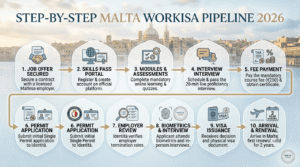

Section 3: Step-by-Step Malta Work Visa Pipeline 2026
Here is the exact chronological process for Indian applicants pursuing Malta work rights 2026:
[Step 1] Secure a Valid Job Offer from a Malta-registered employer
     ↓
[Step 2] Register on the Skills Pass Portal + Pay €250
     ↓
[Step 3] Complete 20–24 hours of online modules (within 42 days)
     ↓
[Step 4] Pass the 20-minute live English video interview
     ↓
[Step 5] Receive Pre-Departure Certificate
     ↓
[Step 6] Employer files Single Permit application with Identità
     ↓
[Step 7] Visa Approval + Travel to Malta
     ↓
[Step 8] Register biometrics on arrival, collect permit card
Documents you will need at Step 6:
- Valid Indian passport (minimum 12-month validity beyond intended stay)
- Pre-Departure Certificate
- Signed employment contract
- Educational qualification certificates (attested)
- Police Clearance Certificate
- Medical fitness certificate
- Proof of accommodation in Malta
Realistic Timeline: From job offer to landing in Malta — expect 60 to 90 days minimum under the new system. Anyone promising faster results without the Pre-Departure Course is lying to you.
Section 4: The Big Upgrade — 2-Year and 3-Year Work Permit Renewals
Here is the good news buried under all the new rules.
Malta work rights 2026 also brings a significant stability upgrade for workers who make it through the new gateway.
From 1 Year to 2 Years
Previously, most Single Permits were issued for 1 year. Under the new framework, TCNs can receive immediate 2-year work permits if their employment contract covers that duration.
This is a massive improvement. It means:
- Fewer renewal cycles
- More employer commitment
- Stronger residency foundation for PR applications
Fast-Track: 3-Year Automatic Renewals
Certain high-value worker categories now qualify for automatic 3-year permit renewals:
| Category | 3-Year Renewal Eligible |
|---|---|
| Key Employment Initiative (KEI) holders | ✅ Yes |
| Specialist Employee Initiative (SEI) holders | ✅ Yes |
| EU Blue Card holders | ✅ Yes |
| Skilled Occupation List professionals | ✅ Yes |
| Standard permit (unskilled/semi-skilled) | ❌ No |
For Indian STEM graduates, nurses, IT professionals, and healthcare workers — this 3-year renewal pathway is your target. It is the fastest route from temporary worker to Long-Term Resident.
🔗 Looking for low-cost European education pathways? Check out Study in Europe Under €10,000 — many programs lead directly to Malta work rights.
Section 5: 2026 Salary Thresholds and Tax Incentives (Updated Numbers)
This is where outdated guides will destroy your planning. The salary benchmarks below are current as of 2026 — not 2024 or 2025.
Malta Visa Salary Requirements 2026
| Visa / Permit Type | Minimum Gross Annual Salary | Processing Time |
|---|---|---|
| Standard Single Permit | Sector-level wage (varies) | 30–60 days |
| Specialist Employee Initiative (SEI) | €25,000/year | 15–30 days |
| Key Employee Initiative (KEI) | €45,000/year | 5 days (fast-track) |
| EU Blue Card | ~€30,000–€38,000/year | 30 days |
The 15% Flat Tax Incentive (For High Earners)
Under the Tax Treatment of Highly Skilled Individuals Rules 2026, specialized professionals earning above €65,000/year gross qualify for a flat 15% income tax rate — significantly lower than Malta’s standard progressive tax brackets that can reach 35%.
This is a major financial incentive for:
- Senior software engineers
- iGaming/fintech professionals
- Healthcare specialists
- Finance and legal professionals
Reality check for Indian applicants: The KEI threshold (€45,000) is out of reach for fresh graduates. Target the SEI route (€25,000) as a realistic entry point with fast-track processing benefits.
Section 6: The Hidden Trap — Employer Termination Rate Thresholds
This section does not exist in most visa guides. It should.
What Is the Jobsplus Termination Rule?
Malta’s Jobsplus authority now monitors employer staff termination rates. If an employer fires too many TCN workers relative to their total headcount, that company is blocked from filing new TCN visa applications — regardless of how qualified you are.
Your visa can be rejected because your future employer fired too many people. You have zero control over this. But you can protect yourself by asking the right questions.
Termination Rate Limits by Company Size
| Company Size | Employees | Rejection Trigger Threshold |
|---|---|---|
| Micro | 1–9 | Exempt |
| Small | 10–50 | >50% termination rate |
| Medium | 51–249 | >45% termination rate |
| Large | 250+ | >40% termination rate |
Questions to Ask Your Maltese Employer Before Accepting an Offer
- “How many TCN workers have you sponsored in the last 24 months?”
- “What is your current staff retention rate among international employees?”
- “Has your company had any Single Permit applications rejected by Identità recently?”
- “Is your company registered and compliant with Jobsplus for TCN hiring?”
A legitimate employer will answer these without hesitation. Evasion is a red flag.
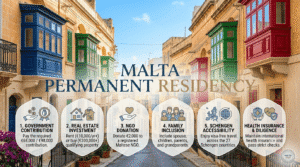

Section 7: Malta Permanent Residency — The Long Game
Malta work rights 2026 are not just about getting a job. For Indian professionals with a long-term plan, Malta is a EU gateway to permanent residency.
The 5-Year Roadmap
Year 1–2  : Arrive on Single Permit, build work history
Year 2–3  : Renew permit (2-year or 3-year under new rules)
Year 4–5  : Accumulate 5 years continuous legal residency
Year 5+   : Apply for EU Long-Term Resident (LTR) Status
LTR status gives you:
- Right to live and work in Malta indefinitely
- Ability to move to other EU countries as an LTR holder
- A clear path toward Maltese citizenship (after 5 more years for naturalization)
The Student Backdoor (Partial Credit Rule)
This is important for students: time spent in Malta on a student visa partially counts toward the 5-year residency requirement.
After graduation, you can apply for a 12-month post-study job-seeker permit — then transition directly to a Single Permit when you secure employment. This compresses the timeline significantly.
🔗 Planning to study in Malta first? Explore Rise Up Education’s Malta Programs Page for university options, fees, and admission support.
Comparison: Malta vs Other European Work Destinations for Indian Applicants
| Factor | Malta 🇲🇹 | Germany 🇩🇪 | Italy 🇮🇹 |
|---|---|---|---|
| Language Barrier | Low (English-speaking) | High (German required) | Medium (Italian helpful) |
| Average Salary | €18,000–€35,000/year | €28,000–€55,000/year | €20,000–€38,000/year |
| Work Permit Processing | 30–60 days | 3–6 months | 2–5 months |
| PR Timeline | 5 years | 5 years | 5 years |
| English Job Market | Strong (iGaming, IT, Finance) | Growing | Limited |
| Cost of Living | Moderate | High | Moderate-Low |
| Post-Study Work | 12-month permit | 18-month permit | 12-month permit |
| 2026 Visa Stability | 2–3 year permits | Up to 4 years | 1–2 years |
Bottom line: Malta wins on language access and speed. Germany wins on salary. Italy wins on cultural experience and cost of living.
🔗 Want a deeper breakdown? Read our Malta search results for more country-specific guides.
Pros and Cons of Malta Work Rights 2026
| ✅ Advantages | ❌ Disadvantages |
|---|---|
| English is the working language | €250 Pre-Departure Course fee (non-refundable) |
| 2–3 year permit stability | 42-day completion window is strict |
| Fast KEI processing (5 days) | Employer blacklist risk (termination thresholds) |
| 15% flat tax for high earners | Small job market vs Germany/UK |
| EU residency pathway | High cost of accommodation in Valletta/Sliema |
| Strong iGaming, IT, healthcare sectors | Competition from EU nationals for skilled roles |
| Post-study work permit available | KEI salary threshold (€45K) unrealistic for freshers |
Real Student Success Stories

Arjun Mehta, 27 — Pune → Malta (iGaming Operations)
“I had 2 years of digital marketing experience and was exploring options. A friend warned me about Malta’s new rules in 2026. I did my research, confirmed my employer’s Jobsplus compliance record — they had zero termination flags — and the application went smoothly. The €250 course felt steep at first, but honestly, the modules taught me things about Maltese employment law I genuinely needed to know. I am now on a 2-year permit and targeting the SEI route on my next renewal.”
Neha Agarwal, 26 — Jaipur → Malta (Nursing, Healthcare Sector)
“I completed my B.Sc. Nursing in 2023 and wanted to work abroad but NEET PG felt overwhelming. I explored Malta specifically because it is English-medium and has high demand for Indian nurses. The Skilled Occupation List includes nurses, so I qualified for the 3-year renewal track automatically. The Pre-Departure Course had a sector module for healthcare workers — it was comprehensive. I am 8 months in and already feeling financially stable in a way I couldn’t have imagined staying in India.”
Rahul Verma, 29 — Delhi → Malta (Fintech, Post-MBA)
“My MBA from a Tier-2 college in Delhi did not open European doors the way I expected. Malta was the entry point I needed. I targeted the SEI route at €25,000 — realistic for my profile. The 5-day processing under KEI was not available to me at my salary level, but SEI processing was still faster than anything I experienced applying to Germany or the UK. The 15% tax incentive is something I am planning my salary negotiation around for my second role in Malta. Long-term plan: LTR status by 2030.”
FAQ: Malta Work Rights 2026 — Most Searched Questions
Q1. Can Indian students work in Malta in 2026?
Yes. Indian students studying in Malta on a student visa can work part-time (up to 20 hours/week in most cases). After graduation, a 12-month job-seeker permit allows you to find full employment before transitioning to a Single Permit.
Q2. What is the Pre-Departure Course for Malta work permit 2026?
It is a mandatory government-registered online course costing €250, covering Maltese employment law, rights, and obligations. All first-time TCN Single Permit applicants must complete it within 42 days and pass a live 20-minute English interview before their employer can file a visa.
Q3. What salary is needed for Malta work visa 2026?
It depends on the visa type. The Specialist Employee Initiative (SEI) requires a minimum of €25,000/year gross. The Key Employee Initiative (KEI) requires €45,000/year. Standard single permits are tied to sector-level wages set by Jobsplus.
Q4. How long does Malta work permit processing take in 2026?
Standard Single Permit: 30–60 days. SEI: 15–30 days. KEI: 5 days. Add 6–8 weeks for the Pre-Departure Course process before the employer can even file your application.
Q5. Is Malta a good option for Indian NEET students who want to study and work abroad?
Malta has limited medical education options compared to Italy or Hungary. However, for nursing, pharmacy, and allied health — Malta’s English-language environment and EU job access make it a strong post-graduation destination.
Q6. What happens if my employer gets rejected by Jobsplus?
If your employer crosses the termination rate threshold, their ability to sponsor new TCN visas is suspended. Your application gets rejected automatically. This is why vetting your employer’s compliance status is critical before accepting any offer.
Q7. Does time on a student visa count toward Malta permanent residency?
Partially. Student visa time partially contributes to the 5-year continuous residency requirement for Long-Term Resident (LTR) status. Your counsellor can calculate your specific credit based on visa type and duration.
Final Action Checklist: Malta Work Rights 2026
Before you take a single step, use this checklist:
- [ ] Confirm your target employer is registered with Jobsplus and has no termination flag
- [ ] Secure a written job offer (signed employment contract)
- [ ] Register on the Skills Pass Portal immediately upon offer acceptance
- [ ] Pay the €250 Pre-Departure Course fee
- [ ] Complete all 20–24 hours of online modules within 42 days
- [ ] Practice conversational English for the live 20-minute video interview
- [ ] Obtain Pre-Departure Certificate upon passing
- [ ] Gather all supporting documents (passport, police clearance, qualifications)
- [ ] Have employer submit Single Permit application to Identità
- [ ] Book flights only after visa approval confirmation
Consult Before You Commit
Malta’s new 2026 system is more structured than it used to be — but that structure protects workers who navigate it correctly. The Pre-Departure Course, English interview, and employer vetting requirements are not obstacles. They are filters that protect you from exploitative employers and unstable visa situations.
If you are serious about Malta, do not rely on random Facebook groups or agency WhatsApp forwards. The rules changed. The data changed. Your strategy needs to change too.
Rise Up Education has guided students and professionals across European destinations including Malta, Germany, and Italy. Our counsellors stay updated on the latest Identità and Jobsplus regulations so you don’t have to decode government portals alone.
📞 Book a Free 30-Minute Consultation → riseupedu.com/malta
📱 Follow us for real-time updates:
External Resources
- Identità — Malta’s Identity and Immigration Authority
- Jobsplus Malta — Employment Authority
- Skills Pass Portal — Pre-Departure Course Registration
- Malta Enterprise — Key & Specialist Employee Initiatives
- EU Blue Card Information — European Commission
About the Author — M Fazeel
M Fazeel is a highly experienced admission counsellor with over 15 years of expertise in guiding students across India and abroad. Recognised among the top education counsellors in India, he has successfully mentored thousands of students who are now pursuing or have completed their education in leading institutions in India and overseas.
He is a well-educated researcher and author, known for providing practical, result-oriented guidance in career and admission planning. M Fazeel also holds professional certifications from the Indian Institute of Technology Delhi, further strengthening his credibility and expertise in the education domain.