

Quick answer: Indian students applying to Canada in 2026 have more real funding options than at any point in the last decade — from the new $100 million University of Toronto scholarship fund (part of a fresh India-Canada talent strategy announced in March 2026) to established awards like the Vanier Canada Graduate Scholarship, Ontario Graduate Scholarship, Mitacs Globalink, and the government-backed Study in Canada Scholarship worth up to CA$12,700. Most are merit-based, a few are need-based, and nearly all have deadlines between September and February for the following intake.
Here’s the part nobody tells you at a consultancy fair: the biggest funding mistake isn’t missing a scholarship — it’s applying to the wrong ones and finding out six weeks before your intake that you’re not eligible. We’ve watched families discover this the hard way, after they’d already paid a non-refundable acceptance deposit.
This guide walks through every legitimate scholarship route open to Indian students in 2026, what each one actually pays, who genuinely qualifies, and the exact order in which you should apply so you don’t waste a submission window. If you’re weighing Canada against other destinations, you may also want to read our breakdown of the real cost of studying in Canada for Indian students in 2026 first — it puts the numbers below in context.
Table of Contents
- The New $100 Million Canada-India Talent Strategy (March 2026)
- Types of Canada Scholarships for Indian Students
- 11 Canada Scholarships for Indian Students in 2026
- Comparison Table: Which Scholarship Fits Your Profile?
- Pros and Cons of Relying on Scholarships
- Eligibility, Cost Offset & Timeline at a Glance
- 7 Mistakes That Cost Students Their Scholarship
- Expert Tips From 15 Years of Counselling Files
- Real Student Success Stories
- FAQs
- Final Word
What Is the New $100 Million Canada-India Talent Strategy?
On March 2, 2026, the Canadian Prime Minister’s office announced a fresh talent and education partnership with India. This is the single biggest update to Canada’s scholarship landscape for Indian students in years, and most study-abroad blogs haven’t caught up with it yet. Here’s what’s actually in it:
- $100 million in funding from the University of Toronto, unlocking up to 200 fully funded scholarships for Indian students
- 13 new university-to-university partnerships between Canadian and Indian institutions, including UBC–O.P. Jindal Global University, Dalhousie–SRM Institute (a dual-degree nursing programme with 25 supernumerary seats), and Algoma University’s pathway agreements with Parul University and Chandigarh University
- Three hybrid academic centres inside India — including a University of Toronto Centre of Excellence and a McGill University AI research hub — so some coursework can begin without leaving home
- Continued backing for the Mitacs Globalink Research Internship, which now includes roughly 300 funded research positions accessible to Indian students
What this means practically: if you’re applying to the University of Toronto, or to any of the 13 partner institutions above, ask your target department directly whether you fall under this new funding round. Because it was announced mid-cycle, many university international offices are still updating their public scholarship pages — a call or email to the admissions office will get you further than a Google search right now.
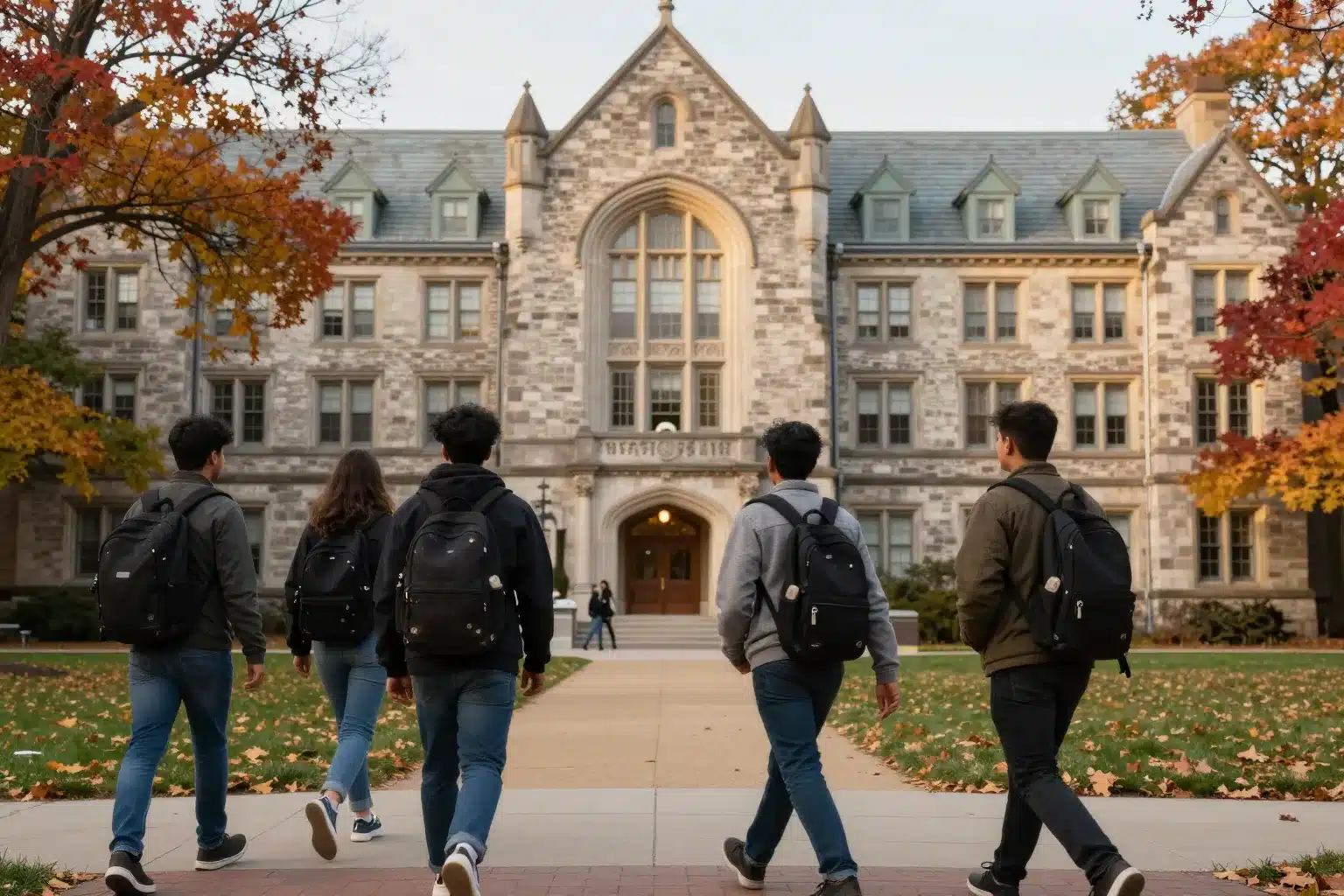
Types of Canada Scholarships for Indian Students
Before the list, it helps to know the three buckets every Canada scholarship falls into. Confusing these is the single most common reason students apply to the wrong award and waste their one shot at a strong application.
Government-funded scholarships come from Global Affairs Canada, provincial governments, or bilateral programmes like the new Canada-India talent strategy. These are the most competitive but also the most generous, often covering full tuition plus a living stipend.
University-funded scholarships are awarded directly by the institution you’re applying to, usually automatically considered at the time of admission based on your academic profile — no separate application in most cases.
Third-party and research-council scholarships come from bodies like Mitacs, IDRC, or private foundations, and typically require a standalone application with its own deadline, separate from your university admission cycle.
11 Canada Scholarships for Indian Students in 2026
1. University of Toronto — India Talent Strategy Scholarships (New for 2026)
Up to 200 fully funded scholarships backed by $100 million in University of Toronto funding, opened as part of the March 2026 Canada-India talent strategy. Coverage details vary by programme; students should confirm directly with the admissions office since the rollout is still being finalised at the department level.
2. Vanier Canada Graduate Scholarships
Canada’s flagship doctoral award, worth roughly ₹41.7 lakh annually for three years. Around 166 are awarded each year, with up to 500 active at any time. You need to be nominated by a single Canadian institution that holds a Vanier quota — you cannot apply directly, so this decision has to be made with your target university’s graduate office before you even submit your application.
3. Ontario Graduate Scholarship (OGS)
A merit-based provincial award worth about ₹4.17 lakh per academic session, open to students with a valid study permit registering for a 2026–27 programme in Ontario. Applications go through your university, not a central portal, and most schools cap the number of student nominations — so ask your programme coordinator about internal deadlines early.
4. Ontario Trillium Scholarship (OTS)
Aimed specifically at international doctoral researchers, worth approximately ₹24.1 lakh, awarded mainly through University of Toronto-affiliated programmes. You cannot hold this alongside an OGS or Vanier award — pick one route with your supervisor’s guidance rather than applying to all three and hoping.
5. Study in Canada Scholarship (Global Affairs Canada)
A short-term exchange award covering up to CA$12,700 (roughly ₹7.6 lakh) for eligible students on exchange or research placements, funded through Global Affairs Canada’s EduCanada scholarship search platform. This is one of the few scholarships genuinely designed for shorter stays, not full degree programmes.
6. Mitacs Globalink Research Internship
A 12-week paid research internship for undergraduates, with a living stipend and travel support, now expanded to roughly 300 positions under the renewed Canada-India cooperation. It’s a strong stepping stone if you’re aiming for a Canadian master’s later, since it gives you a Canadian faculty reference before you even apply.
7. IDRC Research Awards
For master’s or recent doctoral graduates from India, offering an annual value between ₹25.4 lakh and ₹29.4 lakh plus employment benefits, for a one-year paid research placement. Roughly 70 awards go out annually across all eligible developing countries, so competition is real — a strong, specific research proposal matters more than your GPA here.
8. Indo-Pacific Scholarships
Part of Canada’s Indo-Pacific Strategy, this stream has allocated CA$10 million toward scholarships for students from the region, India included. It runs alongside, not instead of, university-specific funding, so it’s worth checking in addition to your institution’s own awards.
9. University of Alberta International Country Scholarship
A first-year entrance award worth about ₹4.17 lakh, automatically considered for Indian students who completed high school in India and are entering an undergraduate programme with fewer than 24 transfer credits. No separate application — it’s assessed alongside your admission file.
10. University of Waterloo International Student Entrance Scholarship
Worth roughly ₹8.3 lakh, awarded to around 20 incoming undergraduates with a 90%+ admission average. Also automatic — but your Admission Information Form (AIF) matters, so don’t treat it as a formality.
11. Dalhousie University Partnership Scholarships
Through the new SRM Institute dual-degree nursing programme and the IIT Tirupati / IISER Tirupati innovation campus, Dalhousie is offering supernumerary seats and dedicated pathway funding for Indian students entering these specific programmes — worth checking if nursing, agriculture, or applied sciences are on your list.
Comparison Table: Which Scholarship Fits Your Profile?
| Scholarship | Best For | Typical Value (₹) | Application Route |
|---|---|---|---|
| U of T India Talent Strategy | UG/PG at U of T or 13 partner institutions | Varies by programme | Confirm with admissions office |
| Vanier CGS | Doctoral researchers | ~₹41.7 lakh/year × 3 | Institutional nomination only |
| Ontario Graduate Scholarship | Grad students in Ontario | ~₹4.17 lakh/session | Through university |
| Ontario Trillium Scholarship | International doctoral researchers | ~₹24.1 lakh | Through university (U of T) |
| Study in Canada Scholarship | Short-term exchange students | Up to ₹7.6 lakh | EduCanada / home institution |
| Mitacs Globalink | UG researchers (12-week internship) | Stipend + travel | Direct application, Mitacs portal |
| IDRC Research Awards | Recent master’s/PhD graduates | ~₹25.4–29.4 lakh | Direct application |
| Indo-Pacific Scholarships | Region-wide applicants incl. India | Part of CA$10M pool | Institutional / EduCanada |
| U of Alberta Country Scholarship | First-year UG from Indian schools | ~₹4.17 lakh | Automatic on admission |
| U of Waterloo Entrance Scholarship | UG with 90%+ average | ~₹8.3 lakh | Automatic on admission |
| Dalhousie Partnership Seats | Nursing, agri-sciences via SRM/IIT Tirupati | Programme-dependent | Through partner institution |
Pros and Cons of Relying on Scholarships to Fund Your Canada Education
| Pros | Cons |
|---|---|
| Genuinely reduces the ₹26–53 lakh first-year cost burden | Most competitive awards require a near-perfect academic record |
| Government and university funding is renewed annually, so it isn’t going away | Deadlines are earlier than your visa timeline — miss them and you wait a full intake |
| Doctoral and research awards often include work/insurance benefits | Doesn’t remove the need to show proof of funds for your study permit |
| New 2026 partnerships mean more seats than in previous years | Some awards (Vanier, OTS) require institutional nomination — you can’t self-apply |
Eligibility, Funding & Timeline at a Glance
| Factor | What Applies |
|---|---|
| Academic threshold | Most merit awards expect 80%+ in relevant coursework; doctoral awards weigh research potential over marks alone |
| English proficiency | IELTS overall 6.0+ (no band below 5.5) is the common baseline referenced across Canadian scholarship criteria |
| Application window | Most scholarships open between September and November for the following intake; a few, like OGS, run on internal university deadlines |
| Proof of funds for study permit | Scholarships reduce your cost but IRCC still requires proof of funds — CAD 22,895 living cost benchmark for a single applicant as of 2026 |
| Stacking rules | Government awards like OGS, Vanier, and OTS generally cannot be held simultaneously — check restrictions before applying to more than one |

7 Mistakes That Cost Students Their Scholarship
Applying after the university deadline, not the scholarship deadline. Many institutional scholarships close their internal nomination list weeks before the official visible deadline — always ask the admissions office for the real cutoff.
Assuming a scholarship covers full tuition. Most partial awards cover 10–40% of costs. Build your budget assuming you won’t get one, then treat any award as a bonus — not the other way around.
Applying to Vanier or OTS without institutional buy-in first. These require nomination, not a personal application. Contact your supervisor or the graduate office before writing a single word of your proposal.
Ignoring newly announced funding because it isn’t “official” on the website yet. The March 2026 University of Toronto fund is a live example — some programme pages simply haven’t been updated. A direct email to the department gets you real answers faster than a search engine.
Weak or generic research proposals for IDRC and Mitacs. Reviewers read hundreds of similar submissions. A proposal tied to a named faculty member’s ongoing research, not a general topic, stands out.
Treating scholarship funds as your IRCC proof of funds. A scholarship letter alone rarely satisfies the study permit’s financial requirement — you still need the GIC or equivalent proof, separately documented.
Applying to every scholarship on a list without checking exclusivity rules. Holding OGS and Vanier simultaneously, for example, isn’t allowed. Read the restrictions section of each award before you submit two applications that cancel each other out.
Expert Tips From 15 Years of Counselling Files
In our experience guiding students through Canadian admissions cycles, the applicants who actually win funding do three things differently. First, they apply to their target university at least two intake cycles before they need to enrol, because automatic entrance scholarships (like Waterloo’s or Alberta’s) are assessed at admission — a late application means missing the scholarship pool entirely, even if you still get admitted.
Second, they treat the Statement of Purpose for scholarship-linked applications as a separate document from the general SOP, tailoring it to the specific award’s stated priorities rather than reusing one generic essay across five applications.
Third, and this is the one families skip most often: they call the university’s international scholarships office directly, especially for anything tied to the new 2026 partnerships, instead of relying only on what’s published online. Funding pages lag behind funding announcements by months in most cases.

Real Student Success Stories
The following are illustrative, composite scenarios based on the kinds of situations Indian students commonly face when applying for Canada scholarships — not verified individual case studies.
“I had a 92% in Class 12 but no idea an entrance scholarship existed until my counsellor pointed it out during my University of Waterloo application. I didn’t have to apply separately — it was assessed automatically. It covered close to ₹8 lakh of my first year, which changed what my parents could afford to say yes to.” — Ananya R., Pune, now pursuing Computer Science at University of Waterloo
“My biggest fear was that scholarships were only for students with perfect grades. I had a solid but not exceptional academic record, and what actually worked for me was the Mitacs Globalink route — a 12-week research internship that built the relationship I needed before I applied for my master’s.” — Rohan K., Ahmedabad, now in a Mitacs-linked master’s programme in Ontario
“We almost missed the Ontario Graduate Scholarship because we assumed it was a central application like the study permit process. It’s actually nominated through the university, with an earlier internal deadline. Once we understood that, we got our documents in with weeks to spare.” — Priya M., Bengaluru, graduate student, Ontario
“When the new India-Canada scholarship news broke in March, I emailed the University of Toronto admissions office directly instead of waiting for the website to update. That one email got me clarity on my eligibility three months before most people even heard about the fund.” — Karan S., Delhi, incoming undergraduate, University of Toronto
Frequently Asked Questions
Is the new $100 million Canada scholarship open to all Indian students?
Not automatically. The fund is tied to the University of Toronto and its 13 partner institutions under the March 2026 talent strategy. Eligibility depends on your specific programme and institution — confirm directly with the admissions office rather than assuming blanket eligibility.
Can I apply for a Canada scholarship without an admission offer?
Most university-funded and government-funded scholarships require you to have applied for, or already hold, admission to a Canadian institution. Standalone awards like Mitacs Globalink and IDRC are exceptions, with their own independent application processes.
Do scholarships affect my study permit application?
A scholarship can strengthen your financial profile, but it does not replace IRCC’s proof of funds requirement. You’ll still need to show the standard living cost benchmark (CAD 22,895 as of 2026) through a GIC or equivalent, separate from any scholarship letter.
What CGPA or percentage do I need for a Canada scholarship?
It varies by award. Entrance scholarships like Waterloo’s typically expect a 90%+ admission average; doctoral awards like Vanier weigh research potential and leadership more heavily than a single percentage figure.
Can I hold more than one Canadian scholarship at the same time?
Sometimes, but not always. Ontario Graduate Scholarship, Vanier, and Ontario Trillium Scholarship specifically restrict simultaneous holding. Always check the “restrictions” clause of each award before applying to more than one in the same cycle.
How early should I start applying for Canada scholarships in 2026?
At least 8–12 months before your intake. Most deadlines fall between September and November for the following year, and university-nominated awards often have internal cutoffs earlier than the public deadline.
Are there scholarships specifically for students with an average academic record?
Yes — research-based routes like Mitacs Globalink and some university partnership seats (such as the Dalhousie–SRM nursing programme) weigh fit, research interest, or programme-specific criteria more than raw marks alone.
Final Word
Canada’s scholarship landscape for Indian students changed meaningfully in March 2026, and most of that change hasn’t fully filtered down to the websites students are searching. The award that fits you best depends on your programme, your target institution, and whether you’re applying for a research-heavy path or a standard undergraduate seat — and getting that match right the first time matters more than applying to every scholarship you can find.
If you’re still deciding between funding routes, comparing them against your total cost of studying in Canada, or want a second opinion on your Canada study visa application strategy, our counselling team reviews applications individually rather than offering generic advice. It’s a conversation, not a sales pitch — and it’s often the difference between applying to the right scholarship once and applying to the wrong ones twice.
You can also read more on Canada’s post-study work permit rules, common reasons Canadian student visas get rejected, our broader list of scholarships for Indian students studying abroad, and options for part-time work in Canada to round out your funding picture.
Follow RiseUpEdu for more updates as the 2026 scholarship cycle unfolds:
Instagram ·
Facebook ·
Threads ·
Snapchat
About the Author – M Fazeel
M Fazeel is a highly experienced admission counsellor with over 15 years of expertise in guiding students across India and abroad. Recognised among the top education counsellors in India, he has successfully mentored thousands of students who are now pursuing or have completed their education in leading institutions in India and overseas.
He is a well-educated researcher and author, known for providing practical, result-oriented guidance in career and admission planning. M Fazeel also holds professional certifications from the Indian Institute of Technology Delhi, further strengthening his credibility and expertise in the education domain.
LinkedIn: https://www.linkedin.com/in/mohammed-fazeel-9a543722/
Twitter: https://x.com/fazeelkhan7