
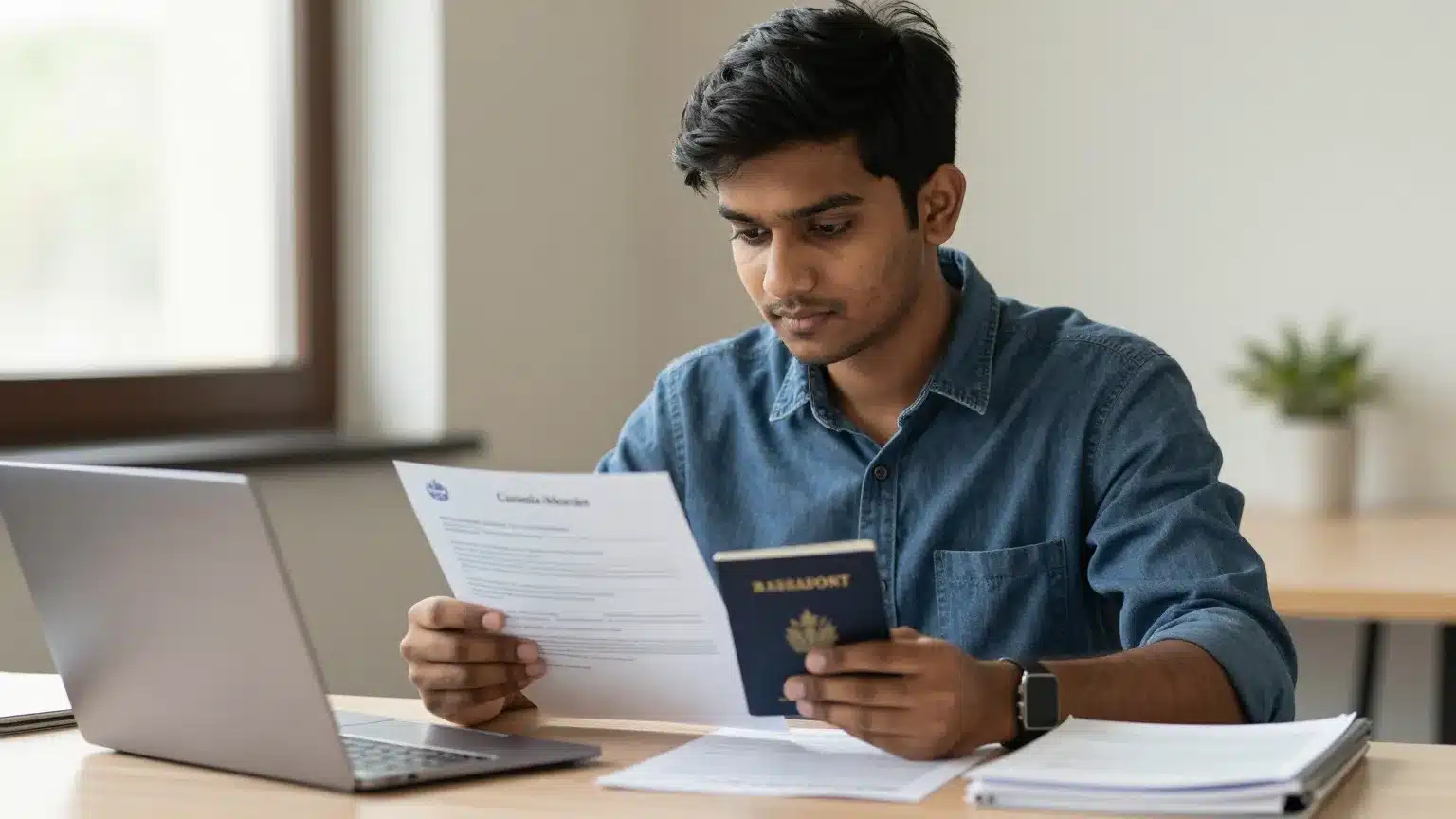
Quick Answer: The Canada study permit process for Indian students in 2026 has nine steps — confirm your Designated Learning Institution (DLI), get your Provincial Attestation Letter (PAL) if your program needs one, take the upfront medical exam, build proof of funds, and apply through your GCKey account. The Student Direct Stream (SDS) that many agents still mention was shut down by IRCC on November 8, 2024 — every Indian applicant now goes through the standard stream, which runs 8–16 weeks. Since July 24, 2026, IRCC also requires documented proof of where your money actually came from, not just a healthy bank balance.
If you’ve been reading Canadian visa consultancy blogs and seeing “SDS processing in 20 days” or “CAD 10,000 GIC gets you fast-tracked,” you’re reading outdated advice. That program is gone, and applying with the wrong assumptions costs families weeks — sometimes an entire intake.
This guide walks through exactly what IRCC asks for right now, in the order it actually happens, with the specific 2026 changes most agents haven’t caught up on yet.
Table of Contents
- Canada Study Permit 2026: The Direct Answer
- Why “SDS” Is the First Thing to Forget
- The 9-Step Canada Study Permit Process
- What Is a Provincial Attestation Letter (PAL) — And Do You Need One?
- Proof of Funds: What Changed on July 24, 2026
- Standard Stream vs. the Old SDS: What Actually Changed
- Pros and Cons of Applying Early vs. Waiting for the Offer
- Cost, Eligibility and Timeline at a Glance
- Common Mistakes That Get Study Permits Refused
- Expert Tips From 15 Years of Counselling Files
- Real Student Success Stories
- Frequently Asked Questions
- Final Word
Canada Study Permit 2026: The Direct Answer
A Canada study permit is the document that lets an international student study full-time at a Designated Learning Institution (DLI) in Canada. It is not a visa by itself — most Indian applicants receive a study permit approval along with a Temporary Resident Visa (TRV) or an Electronic Travel Authorization (eTA), and the physical study permit is actually issued at the Canadian port of entry when you land.
For Indian students specifically, the process runs through the standard study permit stream only in 2026. There is no expedited SDS lane anymore. Processing currently runs 8 to 16 weeks from a complete application, and IRCC has tightened financial-document scrutiny twice in the past 12 months — once on the cost-of-living threshold (September 2025) and again on source-of-funds verification (July 2026).
Why “SDS” Is the First Thing to Forget
This matters more than it sounds. IRCC closed the Student Direct Stream and the Nigeria Student Express program on November 8, 2024. Only applications submitted before 2 p.m. that day continued under the old fast-track rules. Every application filed since then — including everything in 2025 and 2026 — goes through the regular process.
We still see students and even some consultancies budgeting around an old SDS checklist: a mandatory CAD 10,000 GIC, IELTS 6.0 with no band below 6.0, and a 20-working-day promise. None of that is a hard requirement anymore. A GIC still helps your case — more on that below — but it is no longer compulsory, and IELTS requirements now depend entirely on your institution rather than a fixed visa-stream cutoff.
If an agent or a blog post is still quoting “20 working days,” ask them when the page was last updated. If it’s before November 2024, treat every other claim on that page with the same suspicion.
The 9-Step Canada Study Permit Process for Indian Students
Step 1: Get an Offer From a Designated Learning Institution (DLI)
A study permit can only be issued for study at a DLI. Not every college that admits international students holds this status — some private diploma colleges do not. Before you pay any deposit, check the exact institution and campus against the official IRCC Designated Learning Institutions list. Your offer letter will carry a DLI number — cross-check it yourself rather than taking an agent’s word for it.
Step 2: Confirm Whether You Need a Provincial Attestation Letter (PAL)
This is the step that trips up the most applicants in 2026, and it’s covered in full detail below because the rules changed again this year.
Step 3: Take the Upfront Immigration Medical Exam (If Your Course Is 6+ Months)
Indian applicants studying for more than six months need an immigration medical exam completed before or alongside the study permit application — not after. The exam must be done by a physician on IRCC’s approved panel; your family doctor doesn’t qualify unless they happen to be on that specific list, searchable through the official Find a Panel Physician tool. Results are typically valid for 12 months, so book it with your intended filing date in mind, not at the last minute.
Step 4: Book Your English Proficiency Test
Even where a university offers an admissions waiver, sitting IELTS, PTE Academic, or another accepted test strengthens the visa-stage file. The waiver is an academic decision by the institution about coursework readiness — it isn’t proof, to a visa officer, that you meet the language bar. A real score on file removes a variable the officer would otherwise have to take on faith.
Step 5: Build Your Proof-of-Funds Documentation
This is where the July 2026 changes bite hardest, so we’ve given it a dedicated section below.
Step 6: Write a Statement of Purpose That Actually Answers the Return-Intent Question
Your SOP has to cover, specifically and in your own words: your academic and professional background, why this exact course, why this exact institution, why this province, why Canada over studying the same course in India, your career plan after graduation, how ongoing fees will be paid, and — the part most templated SOPs skip — a genuine account of why you intend to return home. Officers read thousands of these. A generic “I have always dreamed of studying in Canada” opening is an instant red flag.
Step 7: Create Your GCKey Account and Submit Online
The formal application goes through a GCKey account — the Government of Canada’s secure sign-in system, separate from the general visa portal. You’ll generate your application forms (including IMM 1294 and IMM 5645 for family information), fill them out, upload supporting documents, and pay the application and biometrics fees. Work through your account’s generated checklist item by item; a document dropped into the wrong upload field is one of the most common, entirely avoidable causes of delay.
Step 8: Complete Biometrics
Within 30 days of submitting your application, you’ll need to visit a Visa Application Centre (VFS Global) for fingerprints and a photo. Book this appointment the same day your biometrics instruction letter arrives — missing the 30-day window can see your application treated as abandoned.
Step 9: Wait for a Decision — and Prepare for Port of Entry
If approved, you’ll get a Port of Entry Letter of Introduction and, where applicable, a passport stamped with a Temporary Resident Visa. The physical study permit itself is issued when you arrive in Canada and present your documents to a border services officer — so keep your acceptance letter, proof of funds, and POE letter accessible in your carry-on, not checked luggage.
What Is a Provincial Attestation Letter (PAL) — And Do You Need One in 2026?
Canada capped international student intake starting in 2024, and provinces now allocate a limited number of study permit spaces. A PAL (or TAL — Territorial Attestation Letter — in the territories) is the document from your chosen province confirming you’ve been assigned one of those spaces. Without it, most applicants cannot even submit a study permit application.
Here’s what changed for 2026, based on the official IRCC update:
- Master’s and doctoral students at public institutions applying on or after January 1, 2026 no longer need a PAL. This exemption is new for 2026 — many older blog posts and even some counsellors still assume every applicant needs one.
- Exchange students, study permit extensions at the same DLI and level, and certain Government of Canada priority groups are also exempt.
- Undergraduate and most diploma-level applicants still need a valid PAL.
- A PAL issued for the 2025 cap year cannot be used in a 2026 application. Unless it states an expiry date, a 2026 PAL is valid through December 31, 2026.
Practical takeaway: don’t request a PAL until your institution has confirmed any conditions on your offer (like an initial deposit) are cleared — most institutions won’t initiate the PAL request before that, and requesting too early can mean requesting the wrong cap-year letter entirely.
Proof of Funds: What Changed on July 24, 2026
Two separate updates now affect how Indian applicants prove they can afford to study in Canada, and stacking them together is where families get caught out.
The living-cost threshold rose to CAD 22,895 for a single applicant, effective September 1, 2025, and that figure still applies through 2026. This is on top of your actual first-year tuition and a realistic return airfare — it isn’t a total budget number, just the living-expense floor.
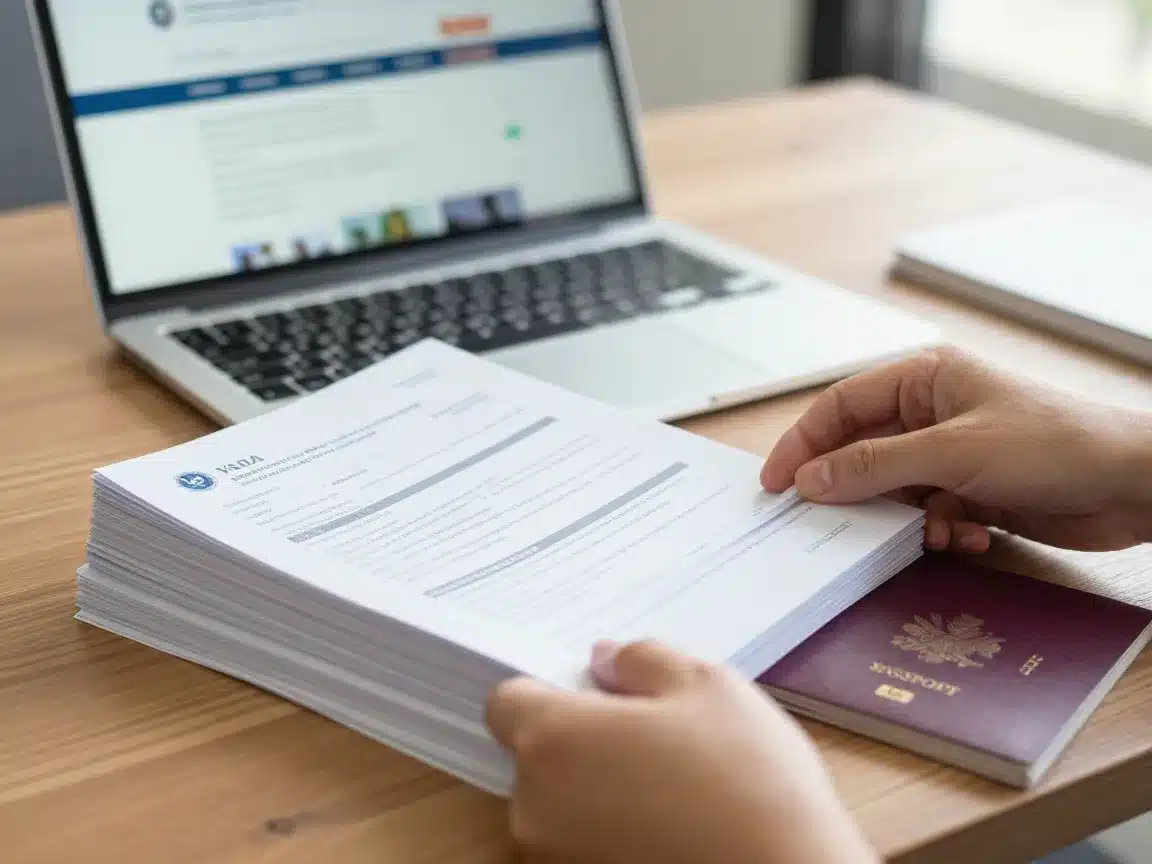
The source-of-funds rule is newer and, in our view, the bigger shift. As of July 24, 2026, IRCC updated officer instructions to require documented proof of where your money actually came from — in every application, not just ones flagged as high-risk. A healthy bank balance is no longer sufficient by itself. Bank statements now need to cover six months (up from four), including the month before or the month of your application.
What this means practically for an Indian family:
- Avoid large, sudden deposits shortly before applying — officers are specifically trained to flag exactly this pattern.
- If a genuine lump sum came in recently (an FD maturing, a land sale, a bonus), attach a source-of-funds letter explaining it, with supporting paperwork.
- Salary slips, ITRs for the last 2–3 years, and — where relevant — an education loan sanction letter carry real weight, because they show a documented, traceable origin rather than a balance that simply appears.
- A GIC (Guaranteed Investment Certificate) with a Canadian bank is not mandatory anymore, but it remains one of the cleanest ways to demonstrate verifiable funds, because the money sits with a regulated institution rather than being taken on trust from an Indian bank statement alone.
Full breakdown of what a full year in Canada actually costs, city by city, is in our detailed cost of studying in Canada guide — worth reading before you finalize how much to show as proof of funds.
Standard Stream vs. the Old SDS: What Actually Changed
| Factor | Old SDS (Closed Nov 8, 2024) | Standard Stream (2026, Applies to All Indian Applicants) |
|---|---|---|
| Processing time | ~20 working days | 8–16 weeks |
| GIC requirement | Mandatory, CAD 10,000 | Not mandatory, but strongly recommended as verifiable proof |
| IELTS requirement | Fixed at 6.0, no band below 6.0 | Set by the institution, varies by program |
| Medical exam timing | Mandatory upfront | Upfront for courses over 6 months, for every applicant |
| Tuition payment | First year required before applying | Not required upfront in most cases; check institution policy |
| Source-of-funds documentation | Not formally required | Mandatory since July 24, 2026, for every application |
Pros and Cons of Applying Early vs. Waiting for the Offer
| Pros | Cons | |
|---|---|---|
| Applying the moment you get an offer | Maximum buffer against the 8–16 week timeline; more room to fix document issues without missing intake | You may request a PAL before your cap-year allocation is confirmed, risking a mismatch |
| Waiting until every document is “perfect” | Fewer requests for additional information mid-process | A 2-4 week delay chasing minor polish can push you past a safe filing window for a September intake |
Cost, Eligibility and Timeline at a Glance
| Item | Detail (2026) |
|---|---|
| Study permit application fee | CAD 150 (~₹9,300), non-refundable |
| Biometrics fee | CAD 85 (~₹5,300), valid 10 years |
| Living-cost proof (single applicant) | CAD 22,895 (~₹14.2 lakh), on top of tuition and airfare |
| Standard processing time | 8–16 weeks from a complete application |
| Biometrics deadline | Within 30 days of application submission |
| Medical exam validity | 12 months from exam date |
| PAL validity (2026 cap year) | Through December 31, 2026, unless otherwise stated |
| Recommended application window | Apply as soon as your PAL and offer conditions are settled — ideally 4-5 months before intake |
Common Mistakes That Get Study Permits Refused
- Budgeting around SDS rules that don’t exist anymore. Families plan around a 20-day timeline that hasn’t applied to any Indian applicant since late 2024, then panic when week six passes with no decision.
- Using a 2025 PAL for a 2026 application. The cap-year mismatch results in an incomplete application, not a simple correction.
- Transferring a large lump sum right before applying. Officers are trained specifically to notice deposits that don’t match six months of prior statement history — and since July 2026, source-of-funds documentation is checked on every file, not just flagged ones.
- Applying for a non-DLI institution. Some private colleges and diploma programs never made the official list. Verify it yourself; don’t rely on a brochure.
- A templated Statement of Purpose. Officers read thousands of SOPs a week. One that never explains genuine ties to India — family, career plans, property, obligations — reads as incomplete regardless of how strong the academic and financial case is.
- Leaving the medical exam for later. Booking it after submitting the application, rather than upfront, is one of the most common reasons files stall in processing.
- Missing the 30-day biometrics window. An otherwise complete, well-documented application can be treated as abandoned over a missed appointment.
Expert Tips From 15 Years of Counselling Files
- Verify your DLI number yourself, twice. Once when you accept the offer, and again right before you file — institution details on the official list occasionally change mid-year.
- Don’t chase “SDS-equivalent speed.” There isn’t one anymore. A complete, well-documented standard application filed early beats a rushed one hoping for a fast lane that no longer exists.
- Pair a GIC with documented income, not instead of it. A GIC shows liquid, verifiable funds in Canada. It does not, by itself, satisfy the July 2026 source-of-funds requirement — you still need to show where the money that funded the GIC came from.
- Write the return-intent section of your SOP last, but never skip it. It’s the section applicants find hardest to write honestly, and the one officers weigh most heavily against an otherwise strong academic case.
- Keep a single folder — physical and digital — of every document you submit, in the exact order the checklist requests. If IRCC sends a procedural fairness letter asking for clarification, you want to respond within days, not scramble to relocate documents.
Real Student Success Stories
The scenarios below are illustrative, composite examples built from patterns we see regularly in counselling files — not individually verified case studies. They’re included to show how these rules play out in practice.
Ananya, Pune — corrected a source-of-funds gap before it became a refusal. Ananya’s family had transferred ₹9 lakh into her father’s account three weeks before they planned to file, from a matured fixed deposit. Once we flagged the July 2026 source-of-funds rule, they attached the FD maturity certificate and a short letter explaining the timeline instead of leaving the deposit unexplained. Her study permit for a September intake at a Nova Scotia college was approved within the standard processing window.
Rohit, Ludhiana — avoided the PAL cap-year mismatch. Rohit had a PAL issued in late 2025 that he assumed would carry over. Cross-checking it against the 2026 cap-year rules caught the mismatch before he filed, saving him a rejected submission and a fresh request cycle that would have pushed him past his intended intake.
Simran, Chandigarh — restructured a generic SOP. Simran’s first SOP draft covered her course and college well but never mentioned why she’d return to India. After rewriting it to include her family’s business plans and a specific role she was targeting back home, the SOP read as a complete case rather than half of one.
Arjun, Kochi — booked his medical exam before submitting, not after. Arjun’s college admission came through late, and he was tempted to file first and book the medical exam afterward to save time. Booking it upfront, alongside document preparation, meant his file had no missing pieces when IRCC reviewed it — a straightforward change that avoided a predictable delay.
Frequently Asked Questions
Is the Student Direct Stream (SDS) still available for Indian students in 2026?
No. IRCC closed SDS and the Nigeria Student Express program on November 8, 2024. Only applications submitted before 2 p.m. that day were processed under the old fast-track rules. Every Indian applicant since then goes through the standard study permit stream, which currently runs 8–16 weeks.
Do I need a Provincial Attestation Letter (PAL) for my Canada study permit in 2026?
Most undergraduate and diploma-level applicants still need one. Since January 1, 2026, master’s and doctoral students at public institutions are exempt, along with exchange students and certain permit extensions. A PAL issued for the 2025 cap year cannot be used for a 2026 application.
How much money do I need to show for a Canada study permit as an Indian student?
The living-cost proof requirement for a single applicant is CAD 22,895, effective since September 1, 2025 — on top of your actual tuition and a realistic return airfare. Since July 24, 2026, you also need to document where those funds came from, not just show the balance.
Is a GIC mandatory for a Canada study permit now that SDS is closed?
No, a GIC is no longer mandatory. It remains a strong, verifiable way to demonstrate funds because the money sits with a regulated Canadian bank, but it does not replace the need to document the source of that money.
How long does the Canada study permit process take from India in 2026?
Standard processing currently runs 8 to 16 weeks for a complete application, though officer workload and requests for additional documents can extend it. Apply as early as your PAL and offer conditions allow — ideally 4-5 months ahead of intake.
What is a Designated Learning Institution (DLI), and why does it matter?
A DLI is an institution officially approved by IRCC to host international students under a study permit. Only study at a DLI qualifies for a study permit application. Confirm the exact institution and campus against the official IRCC list before paying any deposit — some private colleges and diploma programs are not on it.
Can my spouse or children come with me on a Canada study permit?
Your study permit covers only you. If you’re enrolled full-time in a degree-level program (bachelor’s, master’s, or doctorate), your spouse may separately qualify for an open work permit, and dependent children can apply for their own study permits to attend school in Canada. Each is a separate application filed alongside yours, and your proof-of-funds requirement increases to cover them.
What happens if my Canada study permit is refused?
IRCC sends a refusal letter with reason codes — commonly insufficient or undocumented funds, weak ties to India, or an incomplete SOP. Reapplying immediately with the same documents rarely changes the outcome. Address the specific reason cited, strengthen that part of the file, and then reapply.
Final Word
The Canada study permit process for Indian students in 2026 isn’t harder than it used to be — it’s just different, and the biggest risk right now is applying with information that stopped being true in late 2024. Confirm your DLI, work out your actual PAL requirement for your specific program level, get the medical exam booked early, and build a funds file that can survive the July 2026 source-of-funds scrutiny. Done in that order, this is a manageable process — thousands of Indian students are landing at Canadian DLIs on schedule this year.
If you’re weighing Canada against other options, our guides on the Canada scholarships Indian students can actually apply for in 2026 and the 2026 PGWP rules that decide your post-study work options are worth reading before you commit to a province or program. And if you’re looking at ways to manage costs once you land, our piece on how international students can legitimately earn money while studying abroad covers what’s actually allowed under your permit conditions.
Every profile is different — cap-year timing, PAL exemptions, and how your specific funds documentation will read to an officer all depend on details a general guide can’t cover. If you’d like a second set of eyes on your file before you submit, our team offers a free, no-pressure counselling call to walk through your specific situation. You can also find us on Instagram, Facebook, and Threads for regular updates as these rules keep evolving through the year.
About the Author – M Fazeel
M Fazeel is a highly experienced admission counsellor with over 15 years of expertise in guiding students across India and abroad. Recognised among the top education counsellors in India, he has successfully mentored thousands of students who are now pursuing or have completed their education in leading institutions in India and overseas.
He is a well-educated researcher and author, known for providing practical, result-oriented guidance in career and admission planning. M Fazeel also holds professional certifications from the Indian Institute of Technology Delhi, further strengthening his credibility and expertise in the education domain.
LinkedIn: https://www.linkedin.com/in/mohammed-fazeel-9a543722/
Twitter: https://x.com/fazeelkhan7
Sources: IRCC – Study Permit, IRCC – Student Direct Stream Closure, IRCC – 2026 PAL/TAL Update, IRCC – Proof of Financial Support. Information accurate as of August 2026; immigration rules change without notice — verify current requirements on canada.ca before applying.